We partnered with the Greater Manchester Institute of Technology (GMIoT) to lead a comprehensive regional campaign that spanned video production, website development, social outreach, and full-funnel marketing, designed to increase awareness and engagement with Level 3 and Level 4 technical education across Greater Manchester.
Case Study
Institute of Technology
Partnering with the Greater Manchester Institute of Technology (GMIoT) to lead a comprehensive regional campaign that spanned video production, website development, social outreach, and full-funnel marketing.
Client
Goal
Our goal was to increase awareness, engagement, and enrolment in Level 3 and Level 4 technical education across Greater Manchester by delivering a coordinated, full‑funnel marketing approach that connected learners and employers with clear, accessible pathways into technical education, while improving efficiency, data visibility, and return on investment for a public‑sector institution.
Delivery
Working with their partner institutions including the University of Salford, Wigan & Leigh College, Bury College, Tameside College, Ada College, and Trafford & Stockport College, we coordinated and delivered a full creative strategy. This included video and photography shoots, interviews, and edits designed for multi-channel usage across social media, websites, and events.
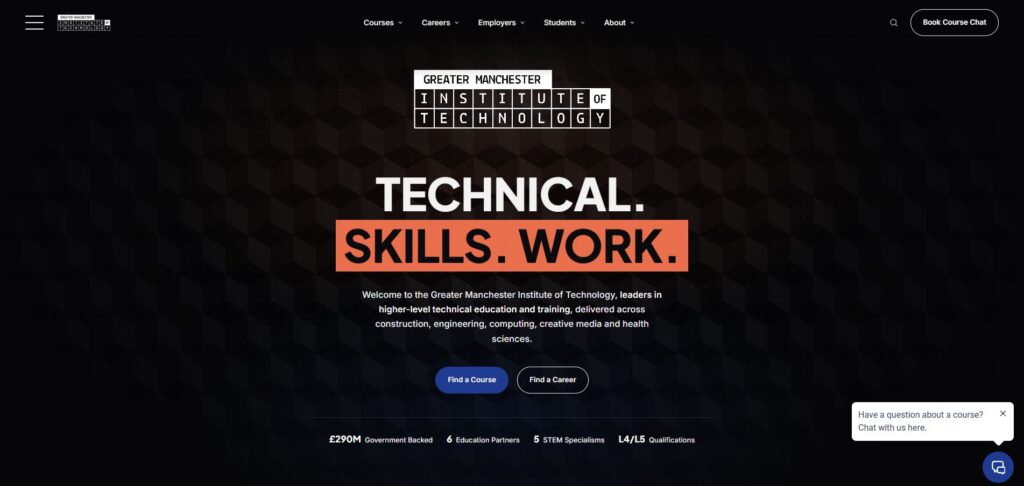
We began by analysing the current market, identifying priority audiences, and producing strategic reports to define the best channels, messaging, and creative approach. Following this, we rebuilt their website with a focus on user journey, accessibility compliance, and GDPR alignment, crucial for public sector digital projects. We integrated platforms including Mailchimp for email workflows and segmentation, and ClickCease for spam protection and better lead management.
To drive meaningful engagement, we designed and managed their social media presence and delivered outreach campaigns for both employers and students. We supported regional events, created a suite of enrichment and employer-focused print booklets, and built email automations to nurture contacts from initial enquiry through to enrolment.
Behind the scenes, we implemented a robust course categorisation and internal tracking system, allowing us to accurately report on the cost per enquiry and cost per enrolment for every campaign. This enabled hyper-targeted advertising, helping us allocate budget toward courses with low enrolment while sustaining performance for high-interest areas.
Outcome
We maintained several overlapping roadmaps and live documents to guide campaign execution, ensuring flexibility across teams while staying laser-focused on outcomes. This approach powered one of the most efficient campaigns the Institute had seen, with a 20% uplift in enrolments compared to the national benchmark of just 2–5%.
By consolidating fragmented agency work, minimising software overheads, and bringing key services in-house, from creative design to digital marketing, we significantly reduced costs while increasing delivery. Public sector organisations often overspend to maintain stability; we gave GMIoT that stability, while simultaneously improving performance, scalability, and impact through a single, unified provider.